Jun 25 2026
H5N1 Avian Influenza
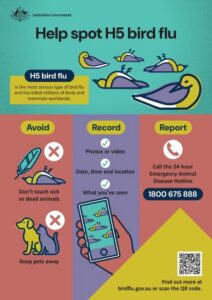
The detection of H5 bird flu in a Brown Skua and Southern Giant Petrel in WA and a Southern Giant Petrel in SA means that the virus has reached the mainland. However, it is early days and the detection is not yet confirmed as “an outbreak” i.e. only three birds confirmed. The government arrangements in place that lead the biosecurity response have not yet called for any mitigation measures such as site closures.
As such, we advise that BirdLife Australia’s bird surveys and bird conservation work may continue as usual. Please follow basic biosecurity procedures as per your existing risk assessments.
To stay up to date with this rapidly emerging situation – you can find BirdLife Australia’s media releases and message around H5 bird flu here – H5N1 Avian Influenza – BirdLife Australia and in our socials https://www.facebook.com/BirdLifeAustralia
For now, our message to volunteers and Birdata users is to stay vigilant, and follow the ‘Avoid, Record, Report’ principles if unusual signs of illness or death are observed. We are aware that different states have different advice regarding thresholds for when to report. As such, we are relying on your skills as bird observers to make the judgment call as to what you regard as unusual signs of illness and death.
For example, if you are out surveying and observe a dead cormorant entangled in fishing line, you do not need to call the EAD hotline as (sadly) this death is not regarded as unusual in an animal disease context. But if you are in doubt, please follow the steps: Avoid Record and Report.
- AVOID contact with sick or dead wildlife and their environment. Do not touch, move or approach the bird, and do not allow pets to touch or eat sick or dead wildlife.
- RECORD what you see, the location the animal was found, and take photos or video (if possible) without approaching the bird.
- REPORT any unusual illness or death in wild birds and other wildlife immediately via the Emergency Animal Disease Hotline (EAD Hotline) on 1800 675 888.
The EAD Hotline is for surveillance and reporting suspected cases of Emergency Animal Diseases. In addition to this, Birdata users are now able to record sick, injured or dead birds within the General Birdata module in the Bird Impact Tracker feature, see more details here – Log sick, injured, or dead birds with Birdata’s new Bird Impact Tracker (BIT) feature. The BIT is still being refined and is presently only available within the General Birdata module – with addition to other modules coming very soon.
Please note that the Bird Impact Tracker is an analytical tool to track the impact of H5 bird flu and is not a reporting tool. BirdLife Australia cannot report sick, injured or dead wildlife for you to the relevant authorities. Whilst we encourage you to record suspected cases into Birdata, as H5 bird flu is a ‘disease of national significance’, there is a legal requirement that all suspected observations of H5 bird flu are reported to the Emergency Disease Hotline.
News

Get the latest news from the AWSG and across the East Asian-Australasian Flyway. More ..
Publications

We produce two publications; our official journal, The Stilt and our Newsletter, The Tattler. More ..
Groups

The AWSG has affiliated groups in every state of Australian and New Zealand. More ..